

How I Test a Rule for Reading the Gospels (Beta)
On this page (5 sections)
Using AI with Scripture is a major problem if you do not control it. Left alone, it will give you an answer that solves your stated goal, and that causes many problems. Some are obvious. The subtle one shows up when you look at AI-generated content and see that the author is not seeking the truth. The author is promoting a position.
So ask yourself: do you own your position, or does it own you?
I have been testing a set of rules for reading the Gospels. Their preliminary results surprise even me.
Beta. This is an early description of work in progress. No rule named in this post is adopted unless I have said yes, and the status of every rule is mine to set.
The short version: I test each rule by splitting the work among helpers who each do one job, by writing down the expected result before any test runs, and by keeping the final decision for myself. The helpers are AI chats. I am the only one who decides.
What the project is
I am testing a set of rules for reading the parallel accounts in the Gospels. The test bed is the Olivet Discourse, which is found in Matthew 24 and 25, Mark 13, and Luke 21.
Two things are tested at once. One is the rules themselves. The other is how well outside readers, which are AI programs on other platforms, can break a rule or defend it.
The test for every rule is the same. A rule stands only if Scripture shows it with named examples, or if denying it would make two passages contradict each other. No rule is allowed to rest on silence. And every rule must say what would make it lose.
The two passages that guide the work
John 17:3 speaks of eternal life as knowing the Father and the Son, and it speaks of that knowing as present. Matthew 5:3 speaks of poverty of spirit. Both are named here by reference only.
How the work flows
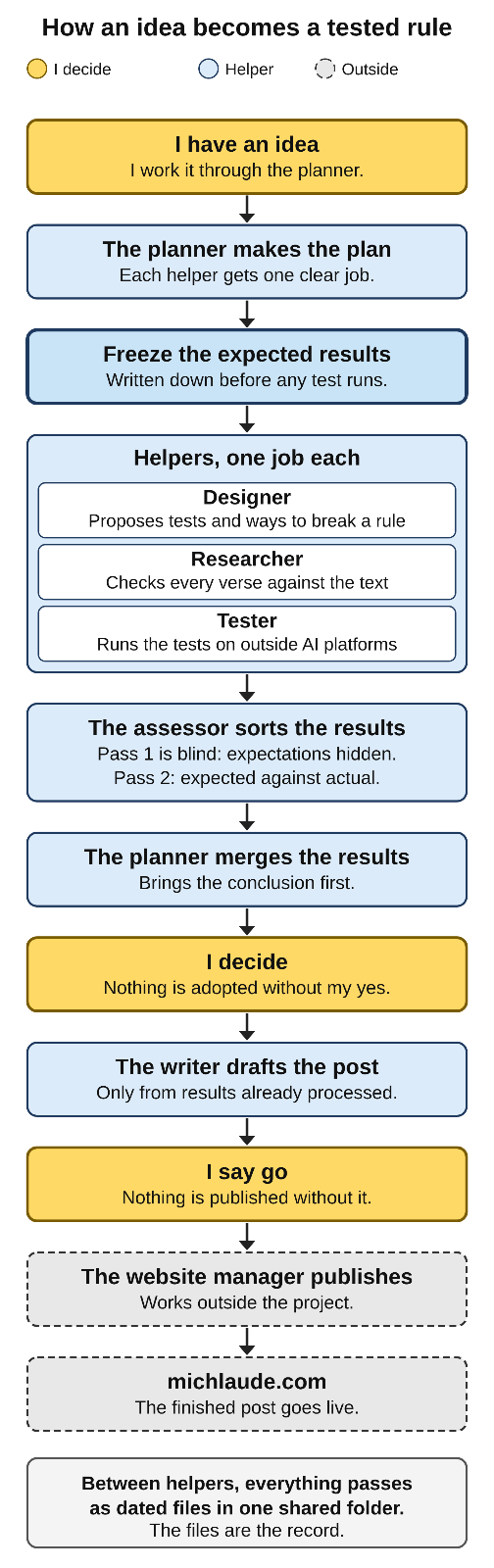
- The idea. I have an idea and work it through the planner, who is one of the helpers.
- The plan. The planner holds the plan and gives each helper a clear job. The planner also writes the expected results with me before any test runs. Then those expected results are frozen.
- The designer. The designer proposes test cases and ways to break a rule. Everything the designer writes is a proposal. The designer is never the reader of his own design.
- The researcher. The researcher checks every verse against a local copy of the Bible text and gets Greek and Hebrew from a second source. Every verse is marked VERIFIED, meaning it was retrieved and matched word for word, or RECALLED, meaning it was not. A recalled passage is never used as a test case.
- The tester. The tester runs the tests on outside AI platforms and records exactly what happened.
- The assessor. The assessor sorts and compares the results. The first pass is blind, which means the assessor reads the raw answers without seeing the expected results. The second pass compares what was expected with what happened. Each platform is reported on its own. Results from different platforms are never added together.
- The merge. The planner puts the results together and brings me the conclusion first, along with the questions only I can answer.
- The decision. I decide. Nothing is adopted without my yes.
- The post. A writer drafts posts from results that have already been processed. A website manager, who works outside the project, publishes them to michlaude.com. Nothing is published until I say go for that exact item.
Between the helpers, everything passes as dated files in one shared folder. The files are the record, because the helpers cannot read each other's minds.
Why it is built this way
Separate jobs. The helper who retrieves does not judge. The helper who sorts the results does not pull verses from memory. The helper who proposes does not check his own proposal. The helper who writes does not decide what is true. Each step is built so that a wrong result has to show itself to someone other than the one who produced it.
Expected results first. The expected result is written down and frozen before any test runs. If a result breaks the expectation, the expectation takes the hit and not the evidence.
A blind first reading. The assessor reads the raw answers before seeing what was expected. That keeps the reading honest.
Outside readers. AI platforms are used as readers because confident AI-written argument is everywhere, and few authors check an AI answer that only agrees with their bias.
I decide. The helpers can test, check, sort and write. They cannot adopt a rule. Only I can.
What this post does not say
This post describes a method. It does not report a result. No finding from any test is presented here as a ruling. Each rule carries a status word, such as Passed, Passed limited, Failed, Untested or Proposed, and I set every one of them. The tests so far use AI readers.
Share this post:Share on Facebook