

Application Note: Running the Michlaude AI Tools from Site Copies on Your Own AI
On this page (11 sections)
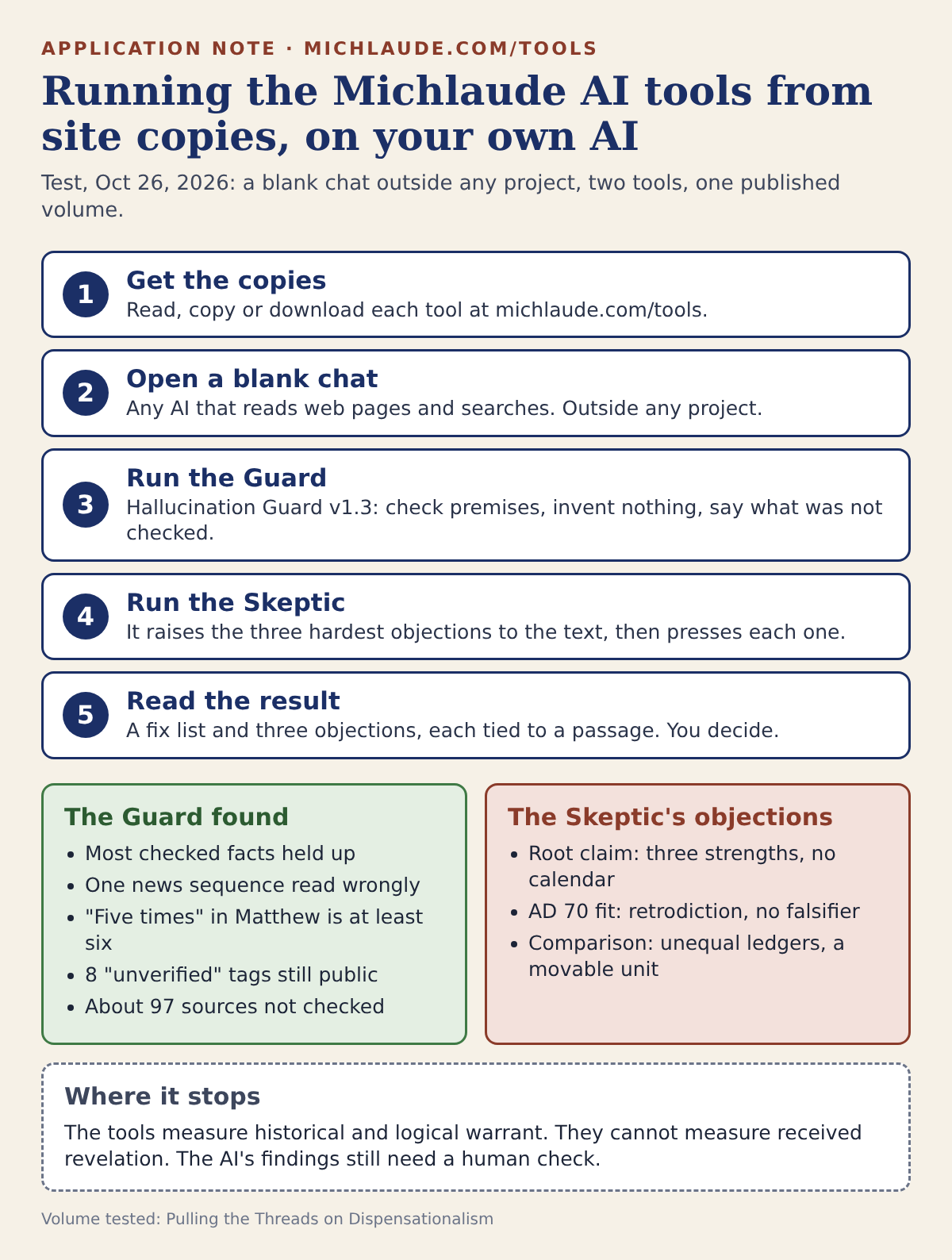
Bottom line. The Michlaude tools run from the copies on this site, on any AI that can read web pages and search, in a blank chat with nothing set up. On October 26, 2026 I tested that: one chat, outside any project, told to fetch the Hallucination Guard from michlaude.com and run it, then load the Methodological Skeptic and run it on the volume Pulling the Threads on Dispensationalism. Both ran. The Guard turned up fixable errors in the public text. The Skeptic returned three objections that hold, and one boundary it cannot cross.
What was tested
- Tools: Hallucination Guard v1.3 and the Methodological Skeptic, both from michlaude.com/tools.
- Target: the public web text of Pulling the Threads on Dispensationalism, including its notes pages.
- Conditions: a blank chat on an AI with web access, outside any project. The AI read nine pages and ran web searches.
- Scope: the AI did not check the roughly 97 cited sources, the quotations attributed to Gundry, Townsend, Kurschner, Walvoord and others, the Hebrew-grammar claims, or the title of Hitchcock's dissertation.
How to run it yourself
- Open michlaude.com/tools. Each tool has its own page and downloads as .md or .txt.
- Open a blank chat on your AI. Give it the address of the Guard, or paste the text in.
- Tell it to follow the Guard for the whole job. Ask it to check the specifics of your text that can be checked.
- Give it the Skeptic (michlaude.com/tools/skeptic) and the text to test.
- Read the output as a list of passages to look at, not as a verdict.
Result one: the Guard pass
The run reports the following. These are its findings as reported, and they have not been re-checked independently.
What the searches showed
- Khamenei strike: The February 28, 2026 US-Israeli strike that killed Khamenei is confirmed by multiple outlets, including the NPR copy the paper's note 79 cites.
- Temple Institute: The "most invalid and unkosher of the heifers in our possession" language is on the Temple Institute's own clarification.
- Sanhedrin: The "fraudsters and swindlers" language appears on a Charisma page that reproduces the statement. The run did not see the November 10, 2025 date directly.
- Charisma, June 30, 2026: The article exists, but it is about a newly born calf in the Galilee, a different event from the 2025 exercise. The paper's sequence reads as though it were a rebound from the correction. Also, a Charisma page the run retrieved (undated in what it saw) relays both statements and says the burned animal was not qualified. That cuts against using the prophecy press as the example of ignoring the correction.
- "This generation": The paper says Matthew uses the phrase "five times in Jesus's teaching." Matthew 12:45 ("this evil generation") is not in its list, so the count is off by at least one. The error favors the paper's argument, but a hostile reader will run a concordance.
What to fix
- The unverified tags: Eight "[unverified — Mike: …]" tags are live in notes 15, 37, 61, 71, 76, 80, 93 and 97.
- Notes 93 and 97: These two sit under body claims, namely the Trump-from-both-directions sentence and the characterization of Hamrick's sermon. As published, both are unsupported assertions. Source them or cut them.
- Hitchcock argument: It infers from the seminary approving a dissertation, and note 76 admits the title is unconfirmed.
- Short Version vs. body on 666: The Short Version says the number "most likely spells the name of a Roman emperor." The body calls Nero "not settled," and note 74 says the needed spelling is attested "if at all."
Result two: the Skeptic
The Skeptic's verdict is that three objections hold. The paper is honest in its concessions, but its headline claims outrun them. It is controlled and courteous, and it does not let the paper off easily. Here are the three hardest objections.
Objection 1: The root claim outruns its own grammar, and the chronology is missing
From the text:
- The Root section opens by asserting the weeks "ran in the first century without a pause."
- By its end, the grammar of 9:26–27 is "evidence, not proof."
- Note 7 says the CDH's Hebrew-syntax claim "has not been checked independently against the Hebrew grammars."
- The paper concedes that nearest-antecedent grammar favors the dispensationalist on "he."
- The closing verdict downshifts again, to "textually argued reasons to think it never did."
That is three strengths of claim for one thesis. Which one is the thesis?
The press:
- The Short Version says AD 70 fit the countdown "finishing right on schedule." In the text the run retrieved, the paper never states when the 490 years start or end.
- Take its own decree candidates from note 41 and count 490 years with no year zero. 538 BC gives 48 BC (538 − 490). 458 BC gives AD 33 (490 − 458 + 1). 445 BC gives AD 46 (490 − 445 + 1). None lands near AD 70.
- If the weeks are literal, AD 70 falls decades outside the seventieth week. The paper's own phrase "within forty years of the cross" confirms it. Then AD 70 is a consequence after the countdown, not the countdown finishing, and the Short Version misdescribes the paper's own reading.
- If the weeks are not literal, "ran its full course" has no measurable content. The exact-day critique of Anderson then loses its target, and the paper loses its calendar.
- The paper concedes that telescoping is real, since "gaps happen in prophecy generally." So what datum would show the clock did stop? Name it.
Objection 2: The AD 70 fit is retrodiction, and the falsifier is left blank
From the text: The paper raises the question itself. Is there any outcome that would have counted against AD 70 as the fulfillment? It answers with a caution (note 39 cites no source). A caution is not a falsifier.
The press:
- Dating the discourse. The paper argues dating at length for Revelation and says it matters. For Matthew and Luke, whose "this generation" and "surrounded by armies" carry the root, the run finds no dating argument. If Luke 21:20 is after-the-fact sharpening, the best evidence for an actionable sign becomes a description of what already happened. What filter excludes legendary development?
- Pella. Eusebius wrote generations later. Note 24 calls Epiphanius "independent" without arguing it. The run recalls that the Pella tradition's historicity is contested, and flags that as something to verify independently.
- The idiom switch. The paper reads temple and armies literally, but the darkened sun, the mourning "tribes of the earth," and the Son of Man on the clouds as judgment idiom. It offers a criterion (Isaiah 13:10, gē as "land") and concedes "That answer works." It works for any hypothesis that needs the narrower reading. Isaiah 13 shows the idiom exists, not that Matthew 24 uses it. The paper charges dispensationalism with this exact form of selective literalism. State the rule before the verse and apply it equally to "temple," "seven years," and "this generation."
- The Maccabean fallback. The paper says that if Daniel is Maccabean, its Matthew 24 case survives because it depends on "when Jesus spoke." But 24:15 names Daniel's abomination. If that was Antiochus, the AD 70 reading is a second application of the same phrase. That is the near/far preview move the paper says futurists must justify. The case survives only as typology, which is the mechanism under dispute.
Objection 3: The comparison runs on an unequal ledger and a movable unit
From the text: The closing tallies nine interpretive choices for dispensationalism. Partial preterism's costs get three named items, plus concessions scattered elsewhere: the Luke 21:24 interval, Acts 1:6–7, Romans 11 left open, 9:27 grammar favoring the other side, the Nero spelling, and a possible late date for Revelation. None of that gets a count or enters the verdict.
The press:
- No unit for "scaffolding." The closing line rests on "this much scaffolding," and there is no unit. Define scaffolding in terms an outsider can count and apply it to both sides. "Not a tie, and not a rout" cannot be reached without that.
- Target mismatch. The sourced claim from dispensationalists is Ryrie's literal/normal hermeneutic (note 1). That is a method claim, not a claim that the chart needs no machinery. The paper's own sources show that tradition arguing in machinery constantly (the CDH on grammar, Hullinger on sacrifices). Note 45 disclaims any claim about what individual believers know. So "Dispensationalism's chart is not what it claims to be" tests the scholarly layer against a popular-layer claim.
- The movable unit. Section 11 blames the system's structure for popular misidentifications, which it calls "unusually well suited to produce it." Section 12 exempts the system from the political package as "not dispensational doctrine." Each is defensible alone. Where is the rule for when popular practice counts against a system?
- A base rate that isn't one. The paper says alternatives do not produce misidentifications "at anything like the same rate." There is no rate and no denominator. Its own list includes papal, Napoleon, and Nero/Domitian identifications from non-dispensational frameworks. "Name one identification from the last century" demands a falsifier from one side only. Name a partial-preterist reading abandoned because the text required it.
- Fault-line symmetry. The paper reports four answers on the church's boundary while admitting the mainstream is consistent and rejects the other three. It also reports partial preterists split on where Matthew 24 hinges. Disagreement inside a shared method does not discriminate unless the rates are compared.
The ceiling
Everything above stays on the bank. The last two paragraphs of "The Measure" do not. The claim that eternal life is a knowing, and that a chart displacing it is something worse than a hobby, rests on received revelation. The claim has moved from an empirical hypothesis to a received, self-sealing framework. The Skeptic's instruments are built to measure historical and logical warrant on the bank. They cannot measure received internal encounter in the water. That is where the methodological dispute ends.
What the test shows
This section is judgment, not a finding from the run.
- The copies are enough. Nothing from a private setup was needed. The site's copy of each tool, a blank chat and a web-capable AI produced work that points at specific notes, sections and sentences.
- The two tools do different jobs. The Guard checks whether the specifics are true and says what it did not check. The Skeptic does not check facts. It tests whether the argument holds together, and it stops where evidence stops.
- The output is a worklist. The Guard's fix list and the Skeptic's objections are things to go and check. Treat the AI's search findings the way you would treat any assistant's: verify before you rely on them.
- Run it on your own text. It works on any sermon, essay, curriculum or argument you can put in front of the AI.
Share this post:Share on Facebook