

another KJV added word instance
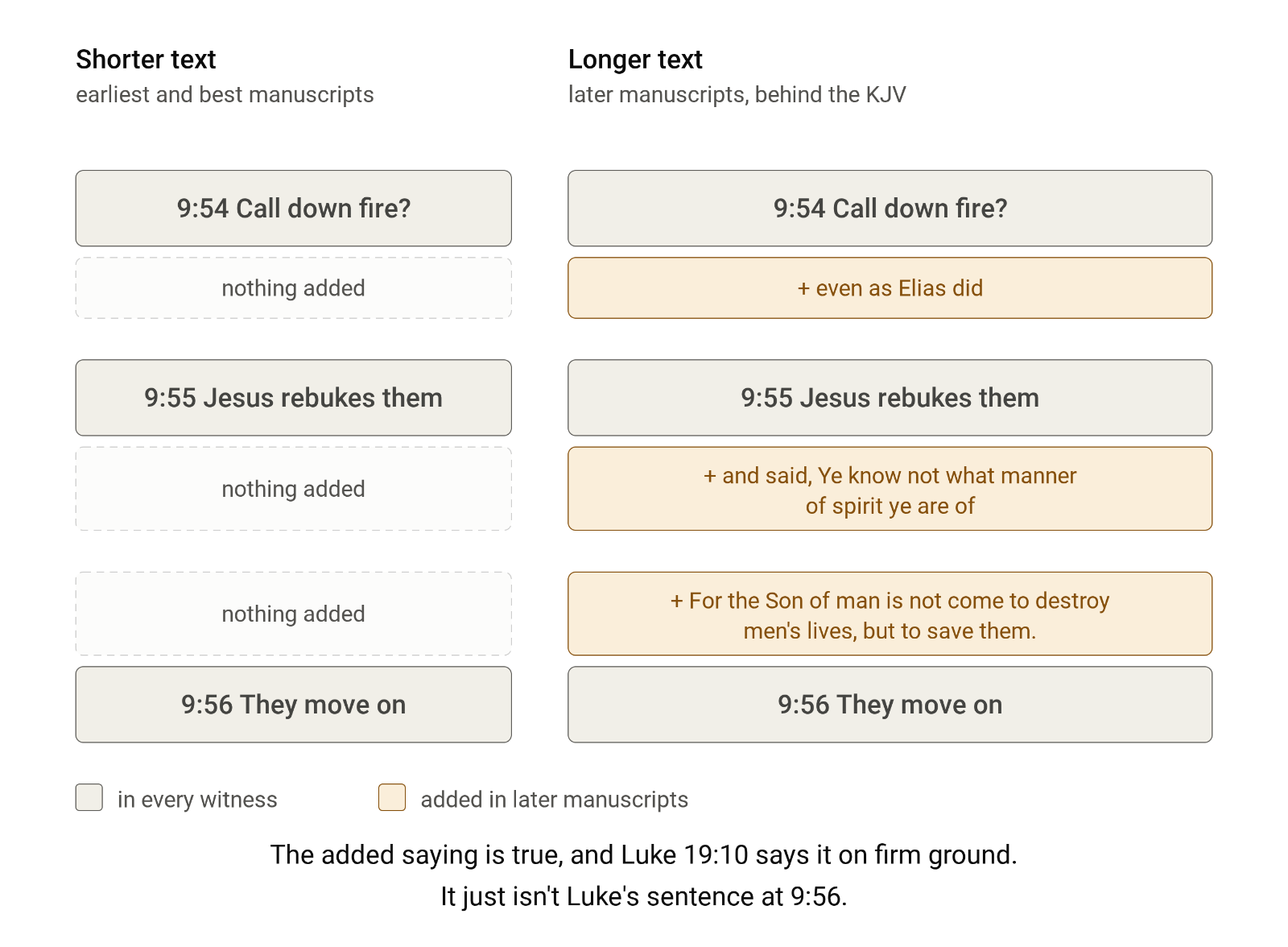
The Saying Luke Didn't Record, and the One He Did
Start with what is already true. The Son of Man came to seek and to save the lost. That is Luke 19:10 in the NET, and nothing about the next few paragraphs touches it.
Now Luke 9. Jesus sets his face toward Jerusalem and sends messengers ahead into a Samaritan village. The village refuses him. James and John ask if they should call fire down from heaven. Luke tells us what happened next in one sentence: Jesus turned and rebuked them, and they went on to another village.
If you read the KJV, you get more. Jesus rebukes them and says, "Ye know not what manner of spirit ye are of. For the Son of man is not come to destroy men's lives, but to save them." Open an NIV or a NET and that saying is gone. Verse 55 ends at the rebuke and verse 56 is the walk to the next village.
So who is right? The KJV translators did not make anything up. They translated the Greek text they were handed, and that text already contained the saying. A scribe put it there centuries before. The NET's footnote says the earliest and best manuscripts lack it and that it is clearly secondary. The reasoning is simple. A scribe who knew Luke 19:10 and John 3:17 had every reason to explain the rebuke, and no one had a reason to cut a line that good. The NET also notes that the same pattern shows up in verse 54, where later manuscripts add "as also Elijah did."
The NIV deserves a fair word too. In the version I checked, it footnotes the Elijah clause but says nothing about the Son of Man saying. A reader comparing the KJV to the NIV finds a gap and gets no explanation. The NET at least shows its work.
Is it a problem? For doctrine, no. What the added line says is true, and the Gospel is secure without it. We have Luke 19:10 and John 3:17 on solid ground.
But it is not nothing. When we say "Jesus said," we should mean Jesus said it, in the text the best evidence gives us. A sentence that arrived in the margin and walked into the text does not carry that weight, however true it is. The earliest Luke gives us a rebuke with no stated content, and a later hand explained it for us. The NET's own study note adds one thing worth keeping. The point of the rebuke is that now is not the time for judgment but for patience, and it points to 2 Peter 3:9.
There is a lesson here for any of us who pick up a Bible and want to feel certain. James and John wanted fire, and they wanted it in the name of loyalty to Jesus. They had no idea what spirit was driving them. The correction was not an argument. It was a turn and a rebuke, and then the walk to another village, with Jesus still leading.
You do not need the saying that scribes supplied to hear the rebuke. You need to keep walking behind him, with empty hands, and let him teach you what he actually came to do. That is not something a footnote can give you. It comes from abiding in him, which is John 15, and which is where the knowing of the Father and the Son begins.
Share this post:Share on Facebook